
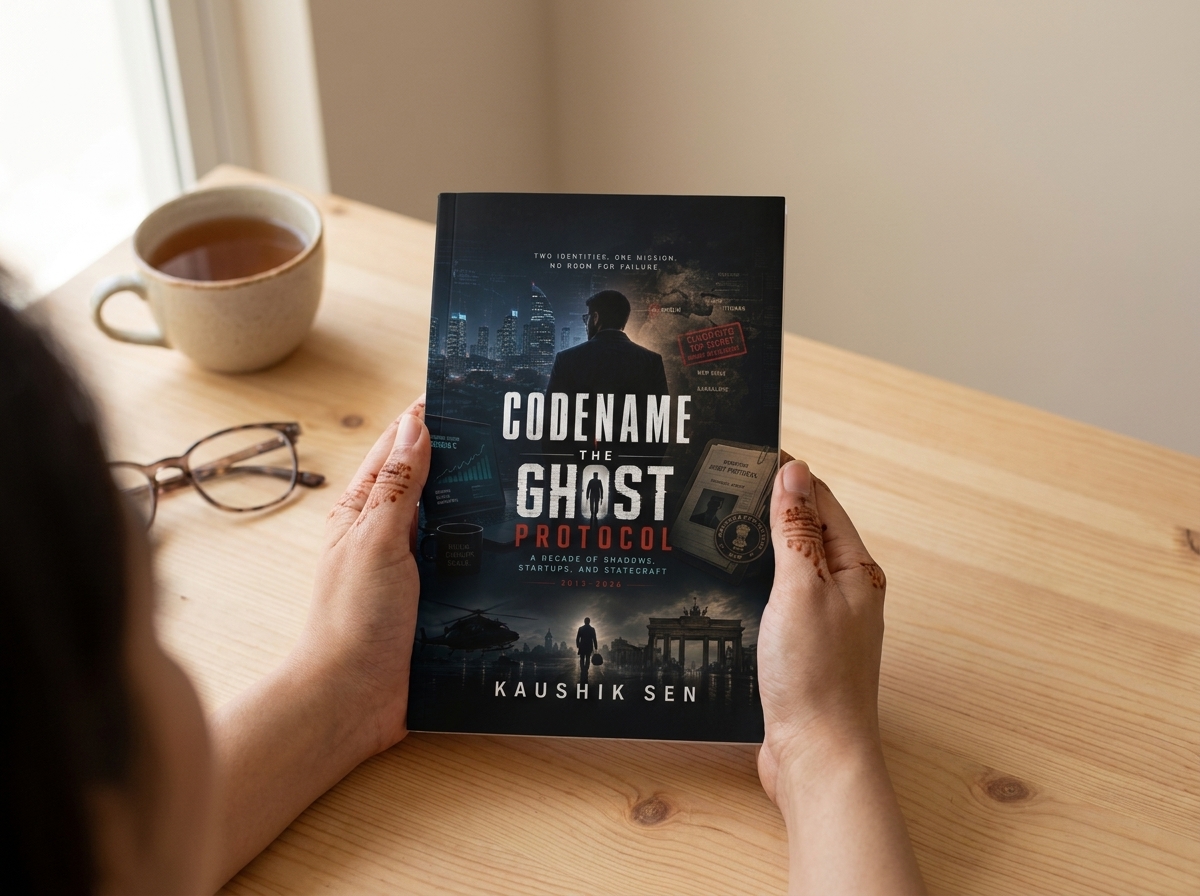
Rating: ⭐⭐⭐⭐ (4.3 out of 5)
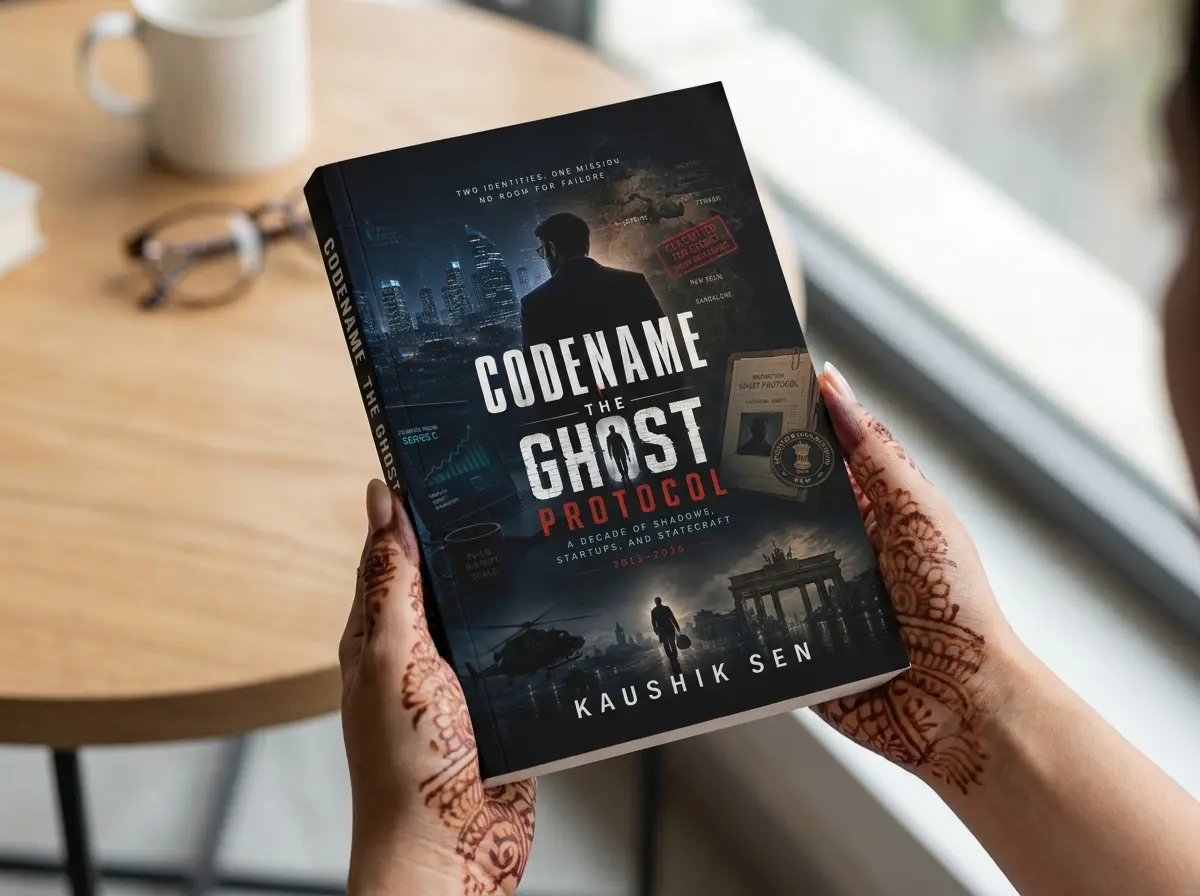
I get a lot of manuscripts pitched to me as “India’s answer to a spy thriller,” and after fifteen years of reviewing books I have learned to read those emails with one eyebrow raised, because most of them are chasing the label without doing the work the label actually requires. Kaushik Sen’s CODE NAME | THE GHOST PROTOCOL is the rare one that earns it. I sat down expecting a fast plot with cover names and close calls, and what I got instead was a novel about a man who has spent twenty six years learning to keep his own hand still while people he loves come apart in front of him. It took me about two chapters to understand this was not going to be a book about missions. It was going to be a book about what a mission costs, paid slowly, in a currency the man can never spend on anyone who actually knows him.
The novel opens on a rooftop party in a glittering Indian tech city, where Keshav Sanyal, the founder of a respected Bengaluru advisory firm called Tessellate, is handed a wine card by a waiter he has never seen before and will never see again. The card carries a cipher, and the cipher carries a name he was not supposed to be able to read. It belongs to an asset he believed was safe. She is not safe. She is dead, and worse than dead, compromised, which means every thread she ever touched now runs somewhere he cannot see. That single card, and the question of who sent it, is the engine of the whole book, though Sen makes the bold choice of setting that question aside for most of the manuscript and taking us back twenty years, to a coal fired power plant in Jharsuguda, Odisha, where a junior engineer named Keshav files a safety report nobody reads, two contract workers die in a silo because of it, and a soft spoken recruiter named Iyer decides this is exactly the kind of person the Research and Analysis Wing has been looking for. From there the book moves through Mangalore, a fog covered training compound outside Delhi, Amsterdam, Zurich, Dubai, Penang and Vienna, building the second life of Keshav Sanyal, field officer, cryptonym the Ghost, one operation and one cost at a time, before finally circling back to the card on the rooftop.
What stood out to me most is how little interest Sen has in the mechanics that usually carry a spy novel. There are no exploding pens here. What he actually cares about is the arithmetic of a double life, and he shows his work. The Jharsuguda opening, with the plant’s general manager standing around in his dressing gown and a glass of good whisky that nobody touches while two men lie dead in a silo they should never have been sent into, sets the tone for everything that follows. It is not a dramatic scene so much as a procedural one, and that is the point, because the horror in this book almost always comes from ordinary people making small, defensible, cowardly decisions rather than from any single villain standing in a doorway.
The Mangalore section gave me the hardest morning of reading in the whole book. A young Keshav is sent undercover among a group of college students to identify a recruiter working a study circle above a shop near the waterfront. He gets close to a lonely nineteen year old named Nadeem, uses the boy’s trust to map the network around him, and then, on the day of a raid that Delhi orders against his own written warning, watches from a rooftop with field glasses as a panicked young constable shoots the boy running through a lane with nothing more dangerous on him than two textbooks and a tiffin box. Keshav’s order is to hold position. He holds it. I have read a fair amount of espionage fiction over the years and I do not remember many scenes that made me set the manuscript down and just sit with it for a minute.
Later in the book, when Keshav’s marriage to a Delhi consultant named Ananya ends during the lockdown, she tells him, more or less, that he has become something so specific there is no room left in it for anyone else, and that observation runs underneath the rest of the novel even though the man himself never once uses a word like tragedy about his own life. That restraint is, I think, the book’s biggest craft achievement. Sen trusts his reader enough to feel the weight without being told to feel it, which is harder to pull off than it sounds and which a lot of writers in this genre never manage.
The emotional charge of the book comes from something Sen names directly through his central image, the ledger. Keshav keeps two accounts of his life. One is the aggregate tally the intelligence establishment uses to judge him, networks disrupted, threats caught early, the kind of number that reads well in a briefing. The other is personal, a private column of names, Nadeem, an Austrian asset named Helena Strauss whose death he cannot fully separate himself from, Ananya, his own mother in Ranchi who still believes her son sells software for a living. He never manages to make those two columns agree, and by the end of the novel he has more or less accepted that they never will. There is a scene near the close, a visit to his old recruiter Iyer in retirement in Mysuru, where Keshav finally asks whether even a long ago failure in a state civil service exam was engineered to push him toward this life, and Iyer’s answer, that both the manufactured story and the real one can be true at the same time, is about as close as this book comes to a thesis statement. Honestly, I sat with that answer longer than I expected to.
If you go into this book expecting the fast, gadget heavy pace people associate with commercial spy fiction, the pacing will feel slower than advertised, and that is worth knowing before you start. This is a novel for readers who enjoyed the way John le Carré wrote about the loneliness inside a cover story more than they enjoyed any particular chase scene, readers who want their intelligence officers to have mothers and consciences and marriages that fall apart on schedule like anyone else’s. It will also appeal to Indian readers who want their espionage fiction actually set in India, in Jharsuguda and Ranchi and Bengaluru, written with real texture instead of borrowed Cold War furniture. If you want the mystery of who sent that rooftop card resolved by chapter three, this book will test your patience, because Sen makes you wait almost the whole way for it.
My honest critique, and I think it is a fair one, is that the long middle stretch covering operations in Zurich, Dubai and Penang occasionally slows the pull of the central mystery, and a reader picking this up expecting a thriller in the commercial sense may feel that tension between the frame story and the flashback more than I did. But I say this as someone who was, in the end, glad the book made me wait, because by the time it circles back to the rooftop, I understood exactly what that card cost the man holding it. In 2026, with so much espionage content built off the same recycled formula, CODE NAME | THE GHOST PROTOCOL feels like a novel someone actually needed to write. Kaushik Sen has built a spy story that cares more about conscience than about plot twists, and I think it will find its readers slowly and keep them for a long time.
A few things readers keep asking me, so let me answer them here. Is CODE NAME | THE GHOST PROTOCOL worth reading? Yes, if you want a spy novel that spends its energy on conscience rather than gadgets, and you are willing to let it take its time. What is the book about? It follows Keshav Sanyal, an intelligence officer working under cover as the founder of a Bengaluru advisory firm, and traces the operations and personal costs that built his double life over more than twenty years. Who should read this novel? Readers of literary espionage fiction, fans of writers like John le Carré, and anyone who wants an Indian spy story rooted in real Indian geography instead of imported tropes. Is this book part of a series? Nothing in what I read points to a sequel directly, though the ending leaves Keshav’s story open enough that one would not surprise me.

With over 11 years of experience in the publishing industry, Priya Srivastava has become a trusted guide for hundreds of authors navigating the challenging path from manuscript to marketplace. As Editor-in-Chief of Deified Publications, she combines the precision of a publishing professional with the empathy of a mentor who truly understands the fears, hopes, and dreams of both first-time and seasoned writers.