
Rating:
⭐⭐⭐⭐ (4.2 out of 5)
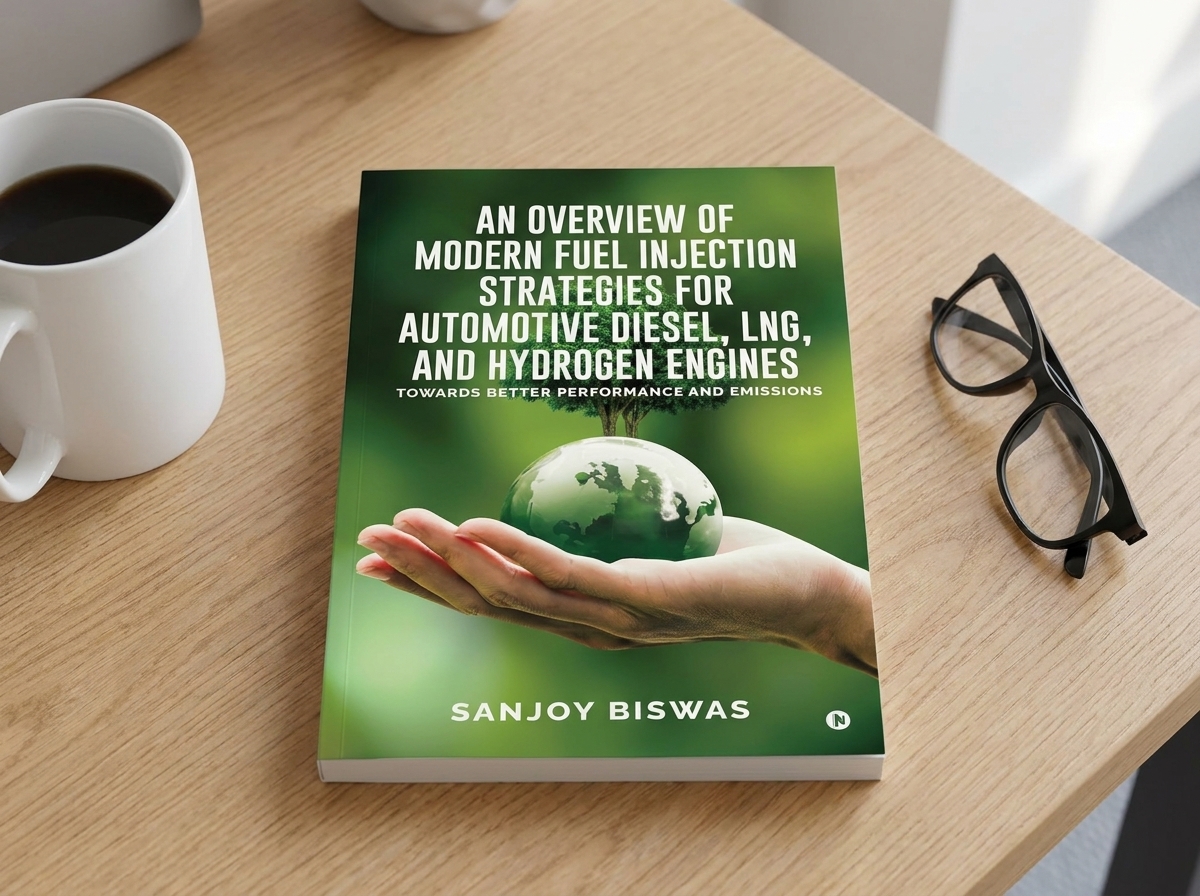
I read a lot of fiction at Deified Publication, so when this one landed on my desk I’ll admit I had to shift gears completely. Sanjoy Biswas’s book, “An Overview of Modern Fuel Injection Strategies for Automotive Diesel, LNG, and Hydrogen Engines,” is not something you curl up with on a rainy afternoon. It’s a research-driven engineering text, and honestly, that took me a page or two to adjust to. But once I settled into its rhythm, I found something I didn’t expect from a book this technical: a genuine sense of a researcher walking you through years of hard-won findings, one chapter at a time.
What the Book Is About
At its core, this is Sanjoy Biswas’s attempt to consolidate his PhD research into something usable for engineering students, researchers, and professionals working in the automotive industry. The book’s central subject is fuel injection strategy, specifically how modern diesel engines equipped with Common Rail Direct Injection (CRDI) technology handle multiple injection events, and how those strategies affect fuel economy, torque, emissions, and combustion noise. He builds his argument around a medium-duty engine used in commercial vehicles, and from there expands into two additional fuel types that are clearly on his mind for the future: LNG and hydrogen.
The book opens with fundamentals. Chapter 1 walks through diesel engine basics, the four-stroke cycle, combustion chamber geometry, and engine peripheral systems like cooling and lubrication. If you’ve studied thermodynamics before, this will feel like a refresher. If you haven’t, Biswas doesn’t leave you behind; he includes the governing equations for IMEP, BMEP, and thermal efficiency in full, with each term explained rather than assumed. By Chapter 2, he’s already moved into CRDI systems specifically, comparing solenoid injectors against piezoelectric ones in a clean side-by-side table that lays out cost, precision, and durability tradeoffs. I appreciated that he didn’t just tell readers piezoelectric injectors are better; he showed exactly where each type wins and where it costs you.
What Stood Out to Me
The heart of the book, for me, is Chapter 6. The objective section there lays out something specific: Biswas set out to test a quadruple injection strategy he calls epMa, which pairs an early pilot and a regular pilot injection with a main and after injection, against two other triple injection schedules, pMa and eMa. He ran this on a heavy-duty BS-IV diesel engine with a 45% EGR fraction, at three engine loads and six different speeds, using Design of Experiments methodology. What struck me is how precise the framing is. This isn’t a vague claim that “multiple injections help.” It’s a controlled comparison with fixed variables, and the results section later admits the epMa strategy still didn’t meet BS-V NOx compliance despite showing the best reduction among the tested strategies. That kind of honesty in a technical book earns trust. He’s not selling a miracle fix, he’s reporting what actually happened on the test bench.
There’s also a section earlier in the book, tucked into the discussion of injector nozzles, that I found surprisingly engaging for something this dry on paper. Biswas walks through how sprayed fuel breaks into droplets, introduces the Weber number as the force governing that breakup, and brings in the Sauter Mean Diameter as the standard way researchers describe droplet size distribution. He credits Hiroyasu and Kadota’s work on multizone combustion models here too. It’s a small section, but it shows he’s not just reporting his own data in isolation, he’s placing it against the wider body of spray and combustion research that came before him.
Then there’s the pivot into alternative fuels in the later chapters, which felt like the book’s most forward-looking material. Chapter 8 includes a comparison table of hydrogen against methane, gasoline, and diesel across properties like octane number, carbon content, and minimum ignition energy. Hydrogen’s numbers are almost startling on the page: zero carbon content, an octane rating above 120, and a stoichiometric ratio nearly ten times higher than diesel’s. Biswas uses this table to explain why hydrogen holds so much promise for reducing NOx while also warning that hydrogen engines carry real risks around knocking, backfire, and pre-ignition depending on which of the three technology paths (PFI-SI, LPDI-SI, or HPDI-CI) a manufacturer chooses. He doesn’t pretend hydrogen is a solved problem, and that balance runs through the whole book.
The Practical Core of This Book
What this book offers isn’t emotional resonance in the way a novel might, but it does something else that matters if you work in this field: it gives you a condensed, structured path through years of testing data that would otherwise be scattered across conference papers and lab reports. The conclusions chapter lists thirteen distinct findings from his multiple injection studies, covering everything from how double pilot injections reduce combustion noise at lower speeds, to how the epMa strategy’s CO and THC emissions compare against four other tested strategies. Reading that chapter felt like getting the executive summary of a much longer research career, and in a field where regulations keep tightening, that kind of consolidated reference has real value in 2026, especially with EU-VII and BS-VII emission norms already shaping how OEMs are approaching engine and after-treatment system design.
Who This Book Is For
This is not a book for casual readers curious about how engines work. It assumes you already have a foundation in thermodynamics and combustion, and it moves fast through equations and DOE terminology without slowing down for beginners. If you are an automotive engineering student working toward a specialization in powertrain or emissions, a researcher in internal combustion engine design, or a professional in the commercial vehicle industry tracking the shift toward LNG and hydrogen platforms, this book is squarely built for you. If you’re looking for a lighter introduction to how diesel engines work, Chapter 1 alone might serve you, but the rest of the book will likely feel dense.
Final Thoughts
I’ll be honest about where the book falls a little short. Some sections, particularly around the vehicle-level noise and fuel economy testing, assume a level of familiarity with test methodology (ESC, ETC, PBN) that a first-time reader might need to look up separately. A short glossary alongside the existing nomenclature list would have smoothed that transition. That said, the strength of this book is that Biswas backs every claim with actual test data rather than general assertions, and the honesty about where his own findings fall short of regulatory targets, like the epMa strategy still missing BS-V NOx limits, is exactly the kind of detail that makes a research book credible rather than promotional.
In my years reviewing books at Deified Publication, I’ve learned that a strong non-fiction technical text is measured less by how it makes you feel and more by whether it changes how you approach your own work. This one does that, provided you’re the reader it’s written for. Sanjoy Biswas has clearly spent years in labs running these tests, and this book is his attempt to hand that hard-earned knowledge to the next set of people working on the same problems.

With over 11 years of experience in the publishing industry, Priya Srivastava has become a trusted guide for hundreds of authors navigating the challenging path from manuscript to marketplace. As Editor-in-Chief of Deified Publications, she combines the precision of a publishing professional with the empathy of a mentor who truly understands the fears, hopes, and dreams of both first-time and seasoned writers.