
Rating:
⭐⭐⭐⭐ (4.2 out of 5)
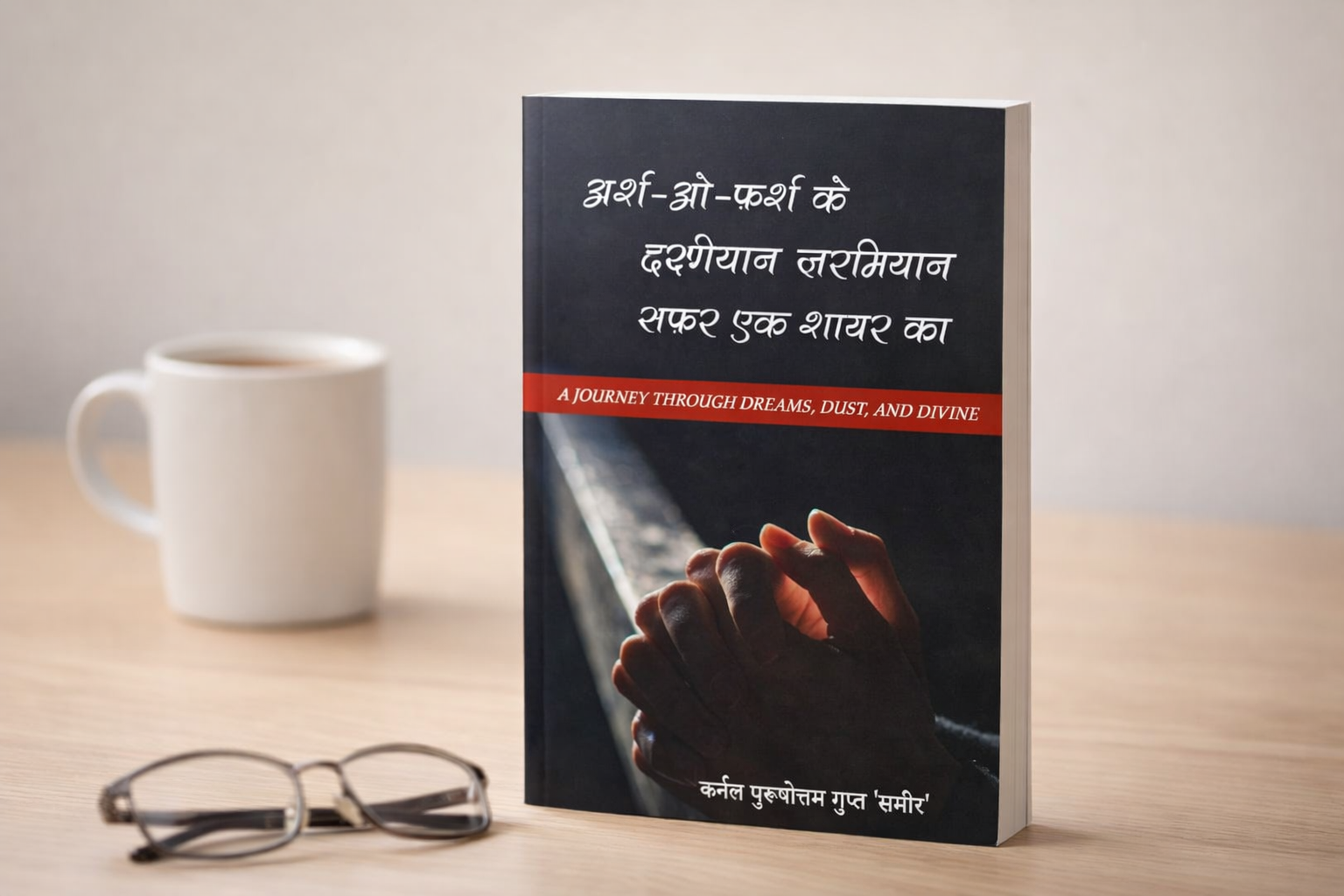
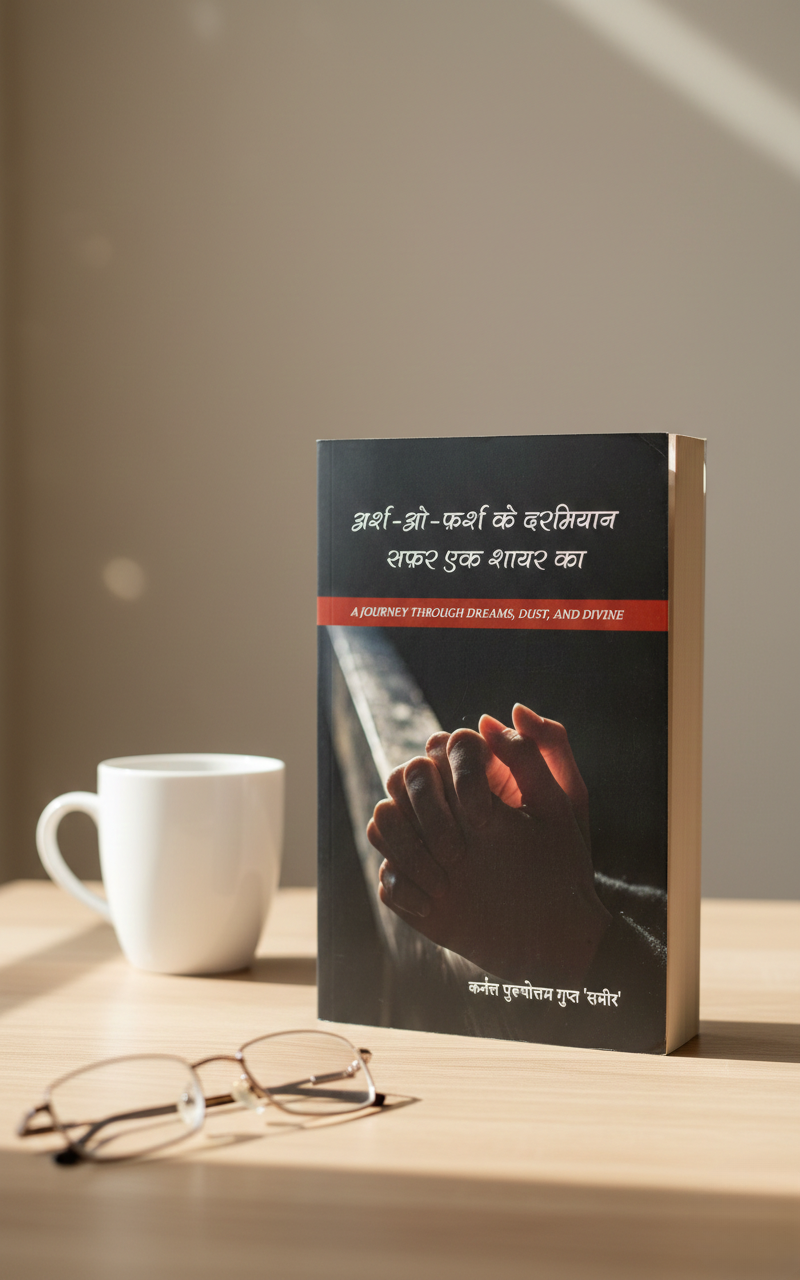
When I first held arsh-o-farsh ke darmiyan – safar ek shayar ka in my hands, I paused longer than I expected to. Maybe it was the cover. Those clasped hands in prayer, half-lit, half in shadow. There’s something about that image that feels deeply personal. Not dramatic. Not loud. Just… honest. As if someone is talking to the sky and the earth at the same time.
And then I saw the name: Colonel Purushottam Gupt ‘Samir’. A soldier. A veteran of 1965 and 1971. A man who has commanded battalions and later turned to poetry. I’ve been reading books for over fifteen years now, and I’ve learned this much: when someone has lived intensely, the writing carries a different weight. You can sense it in the pauses between lines.
So this is my arsh-o-farsh ke darmiyan book review, written after spending real time with the poems inside. And honestly, some of them stayed with me longer than I thought they would.
What the Book Is About
At its core, arsh-o-farsh ke darmiyan – safar ek shayar ka is a collection of Urdu ashaar, nazms, atukant poetry, and a sprinkling of Hindi poems. But that description feels too small for what it actually is.
The title itself is beautiful. “Between the heavens and the earth.” That space between dreams and dust. Between aspiration and reality. Between what we hope for and what we endure.
From the very first few pages, especially the dedication and the early poems, it becomes clear that this is not casual poetry. Colonel Purushottam Gupt ‘Samir’ writes from lived experience. The book opens with deeply personal verses, including a heart-wrenching dedication to his daughter. I had to stop there for a moment. There’s a rawness in those lines. Grief that hasn’t been decorated. Just felt.
Then the tone shifts. We see poems about love, longing, broken promises, betrayal, devotion, nation, faith, time, mortality. There’s one striking line early in the collection where he writes about how when trembling hands could no longer lift a gun, he chose the pen instead. That transition from soldier to poet is not symbolic. It feels real. Like a conscious choice.
The book spans nearly a thousand couplets and poems written over years. And you can sense that this is not a single mood collection. It moves. Sometimes gently. Sometimes abruptly.
If you’re wondering what’s it about in simple terms: it’s about being human. Loving deeply. Losing painfully. Believing anyway.
What Stood Out to Me
In my years reviewing books at Deified Publication, I’ve seen many poetry collections. Some are technically polished but emotionally distant. Others are full of feeling but lack craft. This one, interestingly, sits somewhere in between in a very sincere way.
What stood out first was the emotional range. One poem remembers college love in almost cinematic detail. There’s nostalgia, innocence, and then heartbreak. It felt like watching a memory unfold rather than reading a constructed poem. I kept thinking about how many of us carry that one unfinished story inside.
Then there are the poems dedicated to daughters. As a reader, I found those especially moving. There’s pride, tenderness, vulnerability. Not the stereotypical strong, stoic father. But a father who misses. Who aches. Who remembers.
The language leans heavily into classical Urdu imagery: moon, stars, mehfil, wafa, dard, zulfen. If you grew up listening to old ghazals or reading traditional shayari, you’ll feel at home. At times, I did feel that the imagery was familiar. Not repetitive exactly, but rooted in tradition. Some readers might wish for more contemporary metaphors. But then I reminded myself, this is a poet shaped by a different era. And there’s something comforting in that continuity.
I also appreciated the philosophical pieces. The poem “safar” reflects on life as a long journey with very few resting points. That one stayed with me. The idea that we search for shade all our lives, but often walk alone. It’s simple. But true.
Structurally, the book is not rigid. It flows like a diary of years. That has its charm, though at times I wished for slightly clearer thematic grouping. It would have made the reading experience smoother. But maybe the scattered feeling mirrors life itself.
The Emotional Core
If I had to describe the emotional core of arsh-o-farsh ke darmiyan, I would say it’s longing.
Longing for lost love.
Longing for daughters.
Longing for justice.
Longing for faith.
Longing for meaning.
There’s one recurring undercurrent: despite loss, there is no bitterness. Pain, yes. Disappointment, yes. But not cynicism. And in 2025, I think that matters.
We are living in times where anger is easy. Where outrage is constant. But here is a man who has seen war, personal loss, societal change, and still writes with hope for a brighter tomorrow. That line from the blurb about positivity is not marketing fluff. It genuinely comes through.
There are verses about God, about destiny, about the fragile nature of life. Some lines made me wonder about how we all oscillate between arsh and farsh in our own ways. One day we feel invincible. The next day, we are questioning everything.
I won’t pretend I connected equally with every poem. Some felt more traditional than my personal taste. But that’s the thing with poetry collections. They’re like conversations. You won’t agree with every sentence, but a few will feel like they were written just for you.
And when that happens, it’s worth it.
Who This Book Is For
If you’re asking, should you read arsh-o-farsh ke darmiyan – safar ek shayar ka?
I’d say yes, if:
-
You enjoy Urdu shayari with classical tones.
-
You appreciate poetry written by someone who has lived through war, loss, and public service.
-
You like reflective, faith-infused verses.
-
You don’t mind a traditional style.
It might not be for readers looking for experimental modern poetry or sharp political commentary. This is more inward. More reflective.
It’s also a meaningful read for older readers who may see their own life arcs in these poems. And for younger readers, it offers a glimpse into a different generation’s emotional vocabulary.
As a reader review perspective, I’d say it’s the kind of book you don’t rush. You open it randomly. Read two or three poems. Close it. Sit with it.
Final Thoughts
Writing this arsh-o-farsh ke darmiyan book review, I kept thinking about the image of a soldier choosing a pen over a weapon. There’s something deeply symbolic in that.
Colonel Purushottam Gupt ‘Samir’ doesn’t write like someone trying to impress literary critics. He writes like someone who needed to say these things. And that sincerity carries weight.
Could the book have benefited from tighter editing or thematic structuring? Maybe. A little refinement in sequencing would elevate it further. But even as it stands, there is authenticity here that cannot be manufactured.
As Editor-in-Chief at Deified Publication, I read a lot. Truly. And I’ve learned to value honesty in writing above perfection. This book is honest.
It may not shout. It may not shock. But it speaks. And sometimes, that’s enough.
FAQ
Is arsh-o-farsh ke darmiyan worth reading?
If you enjoy traditional Urdu poetry filled with emotion, faith, and lived experience, yes. It offers heartfelt verses that resonate deeply.
What genre is this book?
It’s a poetry collection featuring Urdu ashaar, nazms, and some Hindi poems.
Who should read arsh-o-farsh ke darmiyan?
Readers who love reflective, classical-style shayari and those interested in poetry by a veteran soldier turned author.
Is this book very modern in style?
Not particularly. It leans toward traditional imagery and classical Urdu expression.

With over 11 years of experience in the publishing industry, Priya Srivastava has become a trusted guide for hundreds of authors navigating the challenging path from manuscript to marketplace. As Editor-in-Chief of Deified Publications, she combines the precision of a publishing professional with the empathy of a mentor who truly understands the fears, hopes, and dreams of both first-time and seasoned writers.