
ReviewMemoir
Reflections Book Review: Warm, Honest Essays on Life
 Review byPriya SrivastavaEditor-In-Chief
- Published
- Reading time
- 7 min
- Readers
- 2,61,373 views · 39 shares
In this review6 sections
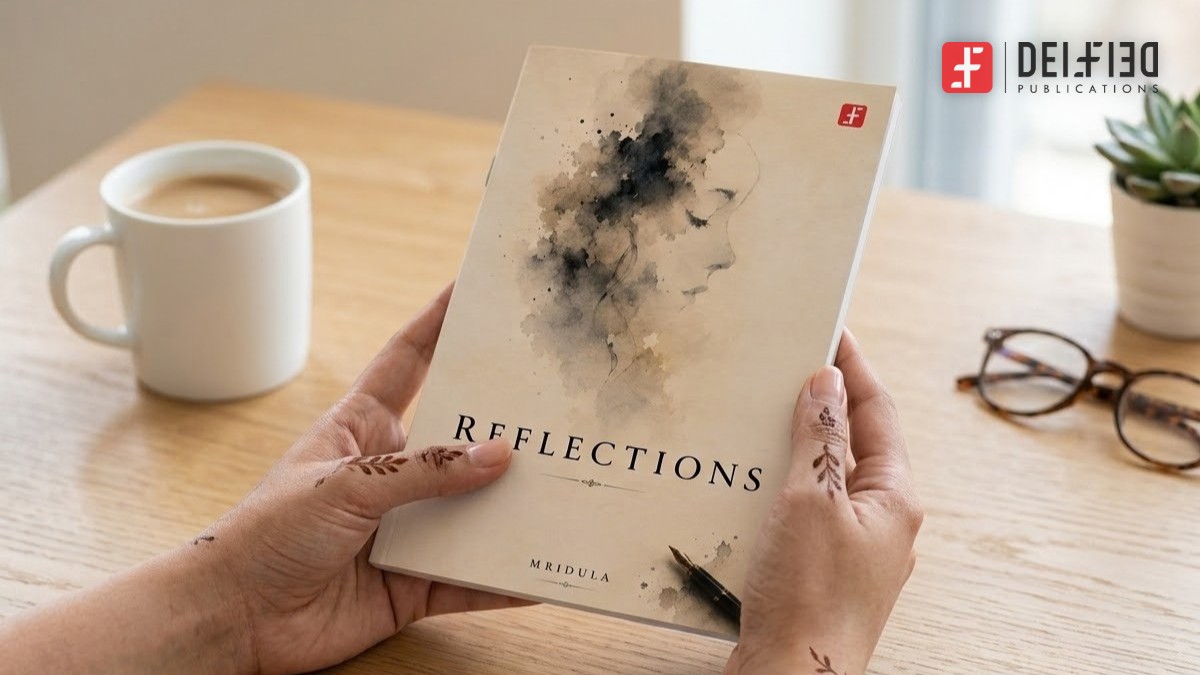
I sat by my office window today, watching the rain hit the glass while my tea grew cold. In my fifteen years of reading books, I have noticed that the stories that truly stick are rarely the ones with massive plots. Instead, they are the simple, honest narratives that make you think about your own family and the choices you made when you were young. That is exactly what happened when I picked up the latest release, Reflections. I wanted something honest to read, and this book felt like a long talk with a cousin you have not seen in years. It has a conversational rhythm that feels natural, like someone is speaking to you from across a kitchen table.
A Closer Look at the Chapters
Let us talk about what is it about in its essence. The book is a collection of personal essays written by Mridula Asthana, structured across four distinct parts. It begins with reflections on her name and her struggle to find her own space as a chartered accountant who chose to leave her career to raise her family. From there, we move into childhood memories of growing up in a massive, chaotic family home in Cuffe Parade, filled with relatives who arrived uninvited and remained for months.
Some of these chapters are incredibly light and funny, especially the ones about her train adventures, while others are heavy and filled with the pain of losing a parent. It is not a traditional memoir that follows a strict timeline from birth to adulthood, but rather a series of snapshots that capture the essence of a life well lived. If you are looking for a book summary, it is best described as an honest attempt to make sense of the compromise, duty, and love that define a woman's existence. The writer does not try to hide the difficult parts of her past, which makes the work feel remarkably brave.
High Heels on Dusty Railway Tracks
What stood out to me immediately was the author's writing style, which is completely free of pretension and big words. Mridula Asthana writes with a straightforward simplicity that reminds me a lot of Sudha Murty's essay collections. There is a wonderful moment in the chapter about her train adventures where she describes her first outstation audit assignment to Ankleshwar. She and her colleague ended up jumping off a moving train because they thought their friend was missing, only to realize the friend was waving at them from the guard's compartment.
The mental image of the author running along the dusty railway tracks in high heels, while strangers cheered them on like they were in an Olympic event, made me laugh out loud. A few pages later, she describes another train trip on Christmas Eve to Amritsar where the family sprinted through the station and got pushed onto the train by helpful porters. They looked around and realized her husband was left behind on the platform because he was paying the taxi driver. These scenes are written with such a light, self-deprecating touch that you cannot help but smile.
The Compromises We Choose
However, the book is not just lighthearted comedy, and some parts hit differently. The emotional core of this collection lies in the essays about the sacrifices women are expected to make in the name of family honor and duty. I found myself thinking about the chapter titled Marriages are Made in Heaven for days after I finished it. In this chapter, the author tells the story of her brilliant cousin, an ICSE topper and doctor who married into a family of doctors in Noida.
Instead of being supported in her career, she was forced to work at a government dispensary, cook every single meal, and wash heavy clothes even during her pregnancy. Her mother-in-law would block the family car on cold winter mornings to prevent her from going to work, and would call her supervisor to complain if she was late. The emotional trauma was so severe that she was almost hit by a local train in Mumbai, saved only by a stranger who pulled her back. It is a devastating piece of writing that shows how easily a woman's spirit can be broken by traditional expectations, and it made me feel a deep, burning anger.
Grief and the Unexplained
There is also a beautiful, mysterious thread about grief and the loss of her mother that runs through the later half of the book. The author describes how, a year after her mother passed away, a crow began visiting her bathroom window ledge, cawing in a strange, distinct voice. While she was initially skeptical of the Hindu belief that feeding crows is a way of connecting with ancestors, she found herself talking to this bird, which would look at her with the same patience her mother once had. This unusual visitor became a source of soft comfort during her darkest days.
Curiously, whenever she asked the bird if her mother was at peace, it would immediately fly away, leaving her with questions that had no easy answers. This balance of the unexplained and the everyday is where the book finds its true strength. It does not try to solve the mysteries of life or offer grand philosophical lessons, but simply presents these moments as they happened. This honesty is why the book feels so genuine, because it reflects the messy, unresolved nature of our own memories.
Reflections Book Review: Who is this collection for?
Now, I must be honest and offer one mild criticism of this work to help you decide if you should read this collection. Because the essays were written at different times as individual pieces, there is occasionally a bit of repetition in the themes and family descriptions. You will find similar mentions of her husband's supportive nature, or her role as a mother, popping up across different chapters in a way that can feel a little redundant if you read the book in one single sitting. I had to look past these minor overlaps as I read.
If you are expecting a tightly structured, fast-paced narrative with high drama on every page, this collection might not be for you. It is a slow, reflective book that is best enjoyed one chapter at a time, perhaps with a warm cup of tea in the evening. But if you appreciate gentle, honest storytelling that captures the ordinary struggles of life, and if you are asking yourself is it worth it to buy this collection, the answer is yes. Published in 2026, it stands out as a lovely piece of personal writing that will appeal to anyone who enjoys memoirs about family dynamics.
Final Thoughts
In the end, this reader review comes down to how a book makes you feel when you close the final page. I closed this book feeling a strange mix of sadness and peace, thinking about my own mother, my own career choices, and the silent battles we all carry without telling anyone. Mridula Asthana has given us something very real and precious here, a book that does not pretend to have all the answers but is brave enough to ask the right questions. It is a beautiful addition to any bookshelf, and I highly recommend it to anyone who wants to slow down and look back at their own history.
Frequently Asked Questions
What is the primary theme of the book Reflections?
The book is centered on the ideas of identity, family expectations, and the emotional resilience required of women. Through a series of personal essays, the author examines how we often lose ourselves in the roles of daughter, wife, and mother, and the difficult process of reclaiming our own sense of self. It also touches on grief, faith, and the everyday moments that shape who we become. This focus on our shared human experiences is what makes these pages so relatable.
Is this book a traditional autobiography?
No, it is not a standard chronological autobiography. Instead, it is structured as a collection of fourteen individual essays that can be read independently. While they do follow the general path of the author's life, from her childhood in a large family to her marriage and career choices, each essay focuses on a specific memory, relationship, or personal reflection rather than a continuous timeline. This modular design allows readers to take their time with each narrative.
Should you read this book if you prefer fiction?
While this is a work of non-fiction, the storytelling is so vivid and character-driven that it often reads like a collection of short stories. The humorous accounts of chasing trains and the struggles of her family members carry a narrative weight that will easily engage fiction lovers. However, if you only enjoy fast-paced thrillers or complex world-building, the slow and reflective pace of these essays might not suit your taste. You should approach it with an open mind and a desire for real, lived experiences.