

ReviewSelf-help
Is This Book Really a Book? Dr. J. Tharcius Under the Lens
In this review5 sections
I still remember the afternoon when a heavy package arrived at my desk, promising a new collection of daily insights. As the Editor-in-Chief at Deified Publication, I receive dozens of volumes every week, most filled with endless lines of standard prose or academic theory. I settled down with my usual cup of warm chai, expecting to read some structured essays on human behaviour and education, but what I found inside was something else entirely. It was an immediate surprise that made me look up from my desk and blink twice, realizing that my usual approach to reviewing would not work here. This was not a standard text, but a collection of images and fragments that demanded a completely different way of looking at a page.
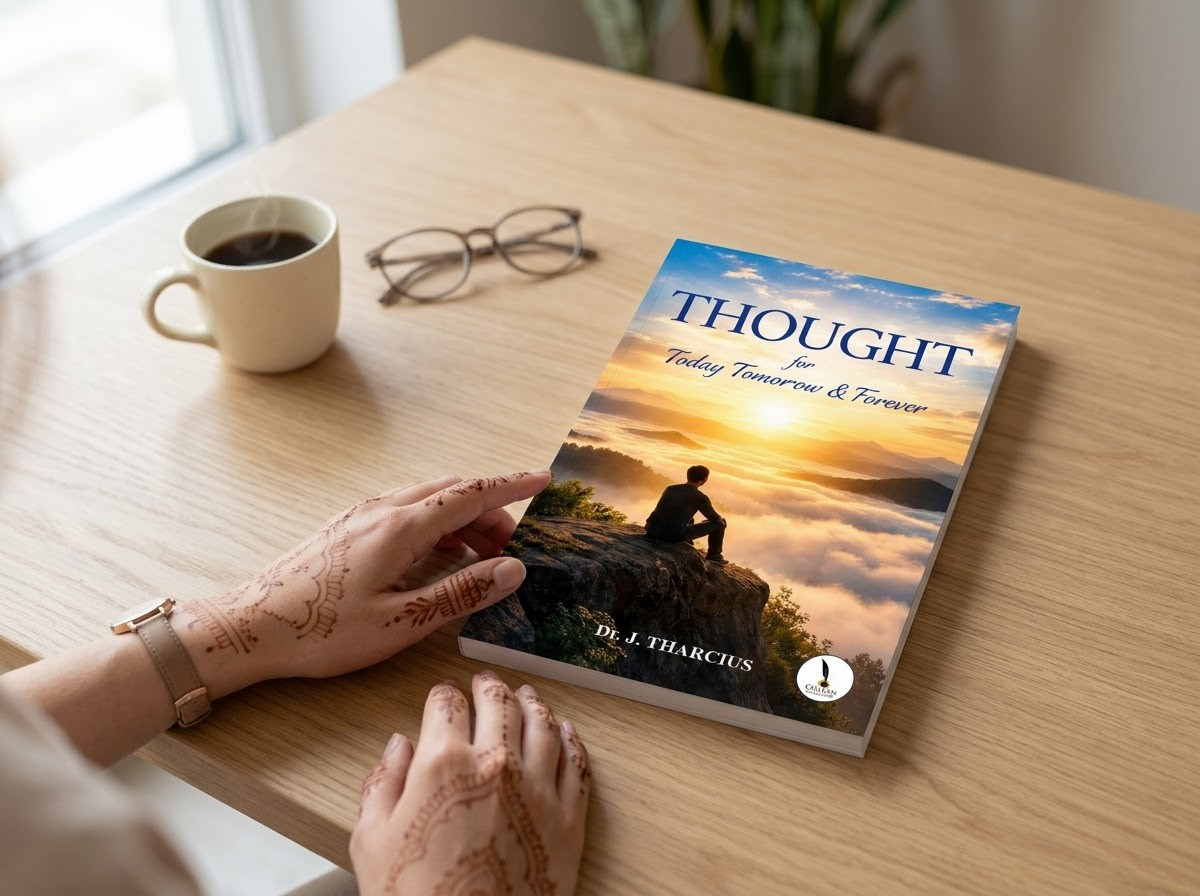
The cover of the book features a classic, serene photograph of a man sitting on a rocky cliff, looking out over a sea of clouds toward a bright sunrise. This image suggests a calm, reflective reading experience, perhaps filled with poetic essays or philosophical prose. However, the moment you open the cover, you are met with a completely different aesthetic that feels highly energetic and visually packed. The contrast between the minimalist cover design and the bustling interior pages is one of the first things that will strike any reader who picks up this work. It sets up an interesting tension between outer calmness and inner complexity.
What This Scrapbook of Wisdom Is About
So, what is it about when we look past that peaceful mountain scene? This is the central question of any reader review trying to make sense of this unique release, and this THOUGHT for Today Tomorrow & Forever Book Review hopes to clarify that. To provide a brief book summary, this volume is not a collection of narrative chapters, but a massive compilation of digital collage plates. Each page is crammed with three or four colourful graphic panels containing moral instructions, historical references, and personal achievements. It is a physical archive of motivational posters, preserved exactly as they might appear on a school bulletin board.
The visual style of the volume is incredibly bold, employing bright primary borders of neon green, yellow, and blue that instantly catch the eye. The individual collage panels are numbered systematically, ranging from lower numbers in the six hundreds up to the eight hundreds on the later pages. Many of these panels carry the author's signature badge, featuring the phrase "Anbudan Ungallil Oruvan," which is Tamil for "With love, one among you." This bilingual element adds a deeply personal, localized touch to the collection, indicating that these materials were originally created for a specific community.
Examining the Craft and Curation
For example, on page 11, we find a panel numbered 667, titled "HAPPY MORNING Life is a Cycle," which tracks a child's development from 2006 to 2013, and finally to 2025. This visual progression is paired with a vintage milk-bottle graphic, showing a simple, graphic way of representing human growth. On the facing page, panel 668 features a framed motivational print stating that the Lord will guide you always, surrounded by small pink floral illustrations. I spent several minutes examining this layout, thinking about how we attempt to summarize complex life transitions through simple, accessible images. It has a homespun, direct quality that is very different from standard publishing.
As I continued reading, I noticed how the book mixes timeless moral wisdom with modern political media clippings. On page 186, we see a gentle illustration of a young child accompanied by a quote about kindness being a language that the blind can see. Right next to this panel, the author has placed a screenshot of Donald Trump with a bold caption reflecting on his life before presidency. This sudden shift from universal spiritual truth to contemporary political media is typical of the book's overall structure, mimicking the diverse stream of information we encounter on modern social media platforms.
This engagement with modern civic life becomes even more pronounced in the final pages, which focus heavily on national elections and democratic duties. From page 187 to page 190, multiple panels feature the slogan "Our Votes Our Rights," decorated with illustrations of inked fingers and voting queues. The author even includes specific calendar dates, such as an April 23 voting date and a May 4 counting date, alongside statistical charts showing voter turnouts. Seeing these highly specific community details placed alongside spiritual quotes was unexpected, making the book feel like a personal journal of a citizen living through a specific historic moment.
The Educator Behind the Collage
To understand the reasoning behind this unusual format, we must examine the extensive professional credentials of Dr. J. Tharcius, which are proudly displayed on the back cover. The author has spent forty-five years in education, serving as a teacher, principal, and director at institutions like St. Bede's Anglo Indian Higher Secondary School. The back cover highlights numerous state and national awards, alongside Guinness World Records for yoga and karate, and Limca records for carving. This background explains why the book reads like a collection of school notice-board posters, as Dr. J. Tharcius has spent his life using visual tools to guide and instruct young minds.
However, should you read this volume expecting a seamless, professional graphic design experience, you will likely find the crowded pages somewhat overwhelming. The sheer variety of fonts, overlapping images, and loud background gradients can make the reading experience feel a bit cluttered and visually exhausting. I also noticed a few minor proofreading oversights, such as the spelling of "apprecite" instead of appreciate on page 112, where a card discusses how a child learns. This lack of polished editorial refinement is a fair criticism, and it suggests that the book was self-published without the benefit of a professional design team.
In terms of literary comparison, THOUGHT for Today Tomorrow & Forever does not fit into any standard category, though it shares some similarities with daily quote anthologies. However, unlike modern, minimalist quote books that use clean white space, this collection is dense, colourful, and completely unpolished. It feels more like a physical scrapbook that a beloved teacher might pass down to his students at graduation, filled with all the clippings he accumulated over his career. This raw, unfiltered quality gives the book a unique charm, even if it lacks the sleek production values of commercial publications.
The Sincerity at the Core
The emotional core of the book lies in its absolute sincerity and its simple desire to offer encouragement to the reader. There is no academic pretense here, and the author's voice, though filtered through borrowed quotes and clip-art, is consistently warm and well-meaning. Looking at panels like the Diwali wishes on page 19 or the warnings about artificial intelligence on page 104, I felt a strong sense of a person trying to make sense of a changing world. It made me wonder about the hundreds of students who must have been cheered by these exact posters in school corridors over the years.
This book is ideal for readers who enjoy visual scrapbooks, daily motivational calendars, and highly eccentric, self-published curiosities that ignore standard design rules. It could be a nostalgic gift for educators or community leaders who appreciate the homespun style of school bulletin boards. Conversely, anyone looking for structured essays, deep psychological studies, or clean modern design should probably pass this one by. It is a highly specialized, intensely personal document of a long life spent in service of education, rather than a standard commercial book.
Honestly, my time with THOUGHT for Today Tomorrow & Forever left me with a deep appreciation for the author's lifelong dedication to his students, despite my reservations about the chaotic design. It is not a title to read in one sitting, but rather a volume to open at random during a slow, calm morning over a cup of tea. There is a genuine warmth within these colourful, crowded pages that manages to shine through the visual noise and the occasional typographical errors. It remains a fascinating, deeply personal project that challenges our standard assumptions about what a book should look like.
Frequently Asked Questions
What is the book summary of THOUGHT for Today Tomorrow & Forever?
This volume is a curated visual collection of over eight hundred numbered digital collage plates, rather than a traditional written narrative. Created by veteran educator Dr. J. Tharcius, the book serves as a colorful scrapbook containing motivational quotes, civic reminders, historical anecdotes, and personal reflections. Each page features multiple vibrant cards combining clip-art, photographs, and bilingual messages in both English and Tamil, designed to provide daily inspiration.
Is it worth it to buy this book for traditional reading?
If you prefer standard books with continuous prose, structured chapters, or deep academic essays, this title will likely not suit your reading habits. However, if you are looking for a unique visual anthology, a physical daily calendar of thoughts, or a nostalgic piece of educational memorabilia, it is worth considering. The value of the book lies in its direct, visual simplicity and its status as a personal archive of a forty-five-year career in school administration.
How does the author's professional background influence the book?
The author's extensive career as an educational psychologist, school principal, and director heavily influences the didactic tone and visual style of the book. The posters and collage cards compiled in the pages mirror the exact type of inspirational materials used in school corridors to encourage discipline, moral character, and civic responsibility. This background explains why the volume feels so much like a school notice board, containing practical guidance for life, learning, and citizenship.
Does the book contain Tamil language text?
Yes, many of the visual collages throughout the book feature text in Tamil alongside English translations or independent Tamil proverbs. The author frequently includes the phrase "Anbudan Ungallil Oruvan" on his cards, creating a bilingual experience that reflects his cultural roots in Tamil Nadu. This feature makes the book particularly interesting for bilingual readers or those familiar with South Indian educational culture, especially with messages looking forward to the voting process for 2026 and beyond.
